Bones, Bodies, and Burials: What the Dead Reveal About the 1845 Franklin Northwest Passage Expedition
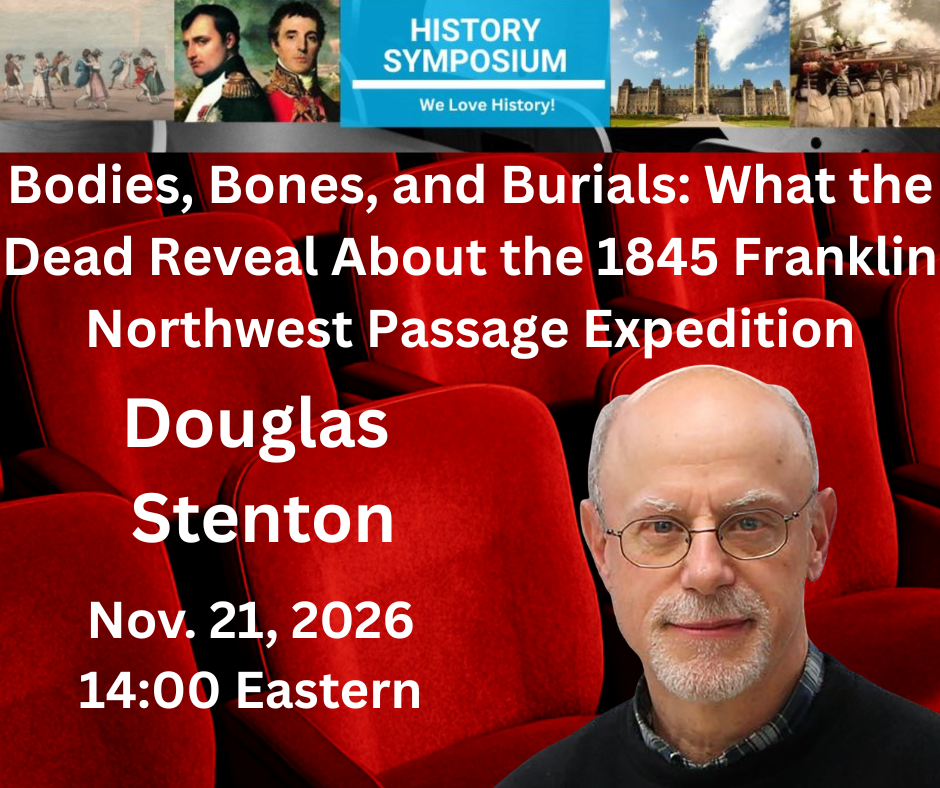
In 1845, Sir John Franklin’s expedition left England aboard HMS Erebus and HMS Terror to map the last uncharted stretch of the long-sought Northwest Passage through the Canadian Arctic. Though among the best-equipped British polar expeditions of its time, both ships became trapped in ice near King William Island and were later deserted. All 129 officers and crew died, transforming the voyage from a mission of exploration and discovery into one of the Arctic’s most enduring tragedies. In this presentation, Dr. Douglas Stenton will discuss how DNA analysis of skeletal remains has identified six expedition members and why these identifications matter for understanding the expedition’s final stages and the human cost behind its legacy.
Douglas Stenton is a Canadian archaeologist whose career has been devoted to the archaeology, history, and cultural heritage of the Canadian Arctic. For more than four decades, he has conducted archaeological research in Nunavut while helping shape the policies and legislation that protect one of the world’s richest archaeological landscapes. His work has advanced understanding of both Inuit history and the fate of Sir John Franklin’s ill-fated 1845 Northwest Passage expedition.
Beginning in 2008, Stenton directed the Government of Nunavut’s archaeological investigations of Franklin expedition sites on King William Island and the Adelaide Peninsula. His team’s investigations integrated archaeological evidence with Inuit oral history and nineteenth-century search records, providing new insights into the movements and final days of Franklin’s crews.
Stenton’s research has led to several important discoveries concerning the expedition. His investigations identified previously undocumented human remains, refined interpretations of the famous Erebus Bay “Boat Places,” and combined archaeology, historical research, facial reconstruction, isotope analysis, and DNA studies to improve understanding of individual expedition members and the circumstances of their deaths. Most significantly, the genetic investigations conducted by his team have resulted in the positive identification of six members of the expedition. His archaeological work also contributed significantly to the collaborative search that culminated in the discovery of HMS Erebus in 2014, one of the most important archaeological finds in Canadian history.
An accomplished scholar, Stenton has authored or co-authored numerous peer-reviewed publications on Arctic archaeology, Inuit history, archaeological resource management, and the Franklin expedition.
Following his retirement from the Government of Nunavut, Stenton became an Adjunct Assistant Professor in the Department of Anthropology at the University of Waterloo, and Adjunct Graduate Faculty in the Department of Anthropology at Trent University.
Stenton’s contributions have been widely recognized. In 2015 he was awarded the Polar Medal for strengthening understanding of Canada’s North and its peoples. That same year he was also awarded Erebus Medal by the Royal Canadian Geographic Society for his role in the 2014 discovery of HMS Erebus. In 2017 he was appointed a Member of the Order of Canada for his enduring contributions to preserving Canada’s northern heritage and for his leadership in Arctic archaeology. In 2019 he received the Distinguished Alumni Award from Trent University in recognition of his commitment and extraordinary contribution to Northern Canada’s cultural heritage and his lifelong dedication to Canadian archaeology. Through his archaeological investigations and his leadership in heritage conservation, he has helped preserve and illuminate the history of Canada’s Arctic for future generations while making lasting contributions to one of the country’s most enduring historical mysteries.
All talks are brought to you on a no charge basis by the History Symposium, a project by the non-for profit/licensed charity Heritage Days.
Heritage Days is building an ecosystem for the hosting of future conferences and talks in the most affordable fashion possible. Please consider donating to the History Symposium to help fund future projects.