December 1813: Conflagration on the Niagara
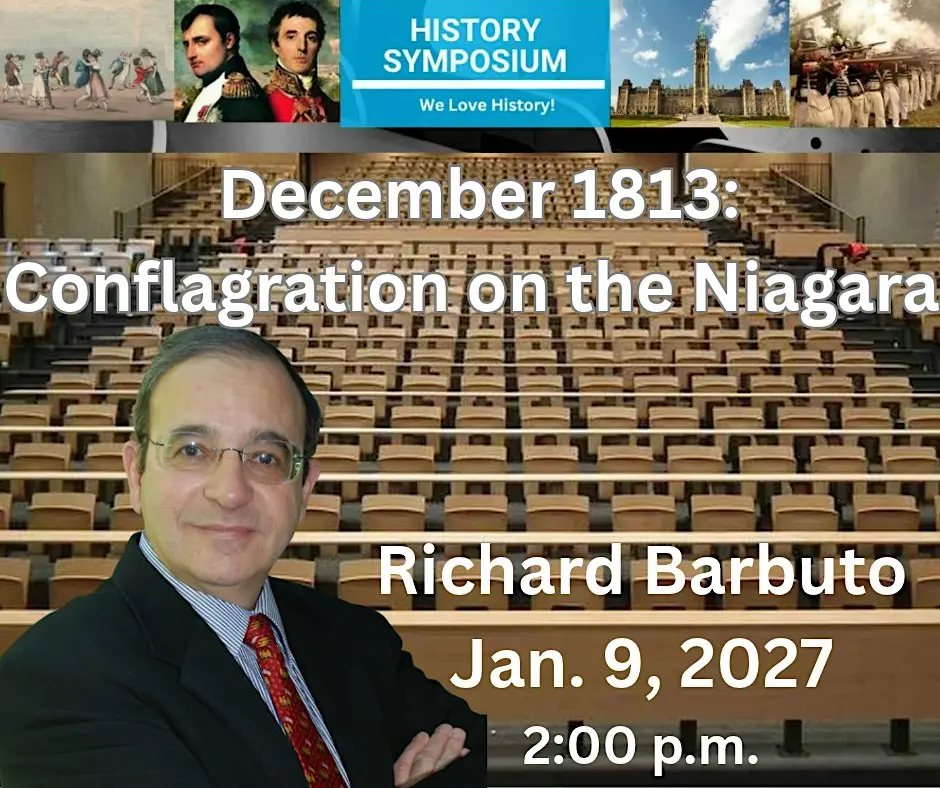
On December 10th, 1813, Brigadier General George McClure directed the burning of the unoffending village of Newark, Upper Canada leaving the homeless inhabitants to their fates. A week later, Lieutenant General Gordon Drummond ordered the seizure of Fort Niagara in a daring bayonet assault. He then conducted a reprisal, burning nearly every dwelling, barn, and shop along the New York shore of the Niagara River. Thousands fled into the snowy forests. This presentation observes this human catastrophe through the eyes of five participants: McClure, Drummond, Dr. Cyrenius Chapin, Lieutenant Colonel Joseph Willcocks, and laundress Betsy Doyle.
Rich was born and raised on the shores of Lake Erie in Dunkirk, New York. Graduating from West Point in 1971, he served as an armor officer for twenty-three years in Germany, Korea, Canada, and other U.S. posts. He earned a Ph.D. in American History from the University of Kansas and was the deputy director of the Department of Military History at the Army’s Command and General Staff College at Fort Leavenworth, Kansas, for twelve years. He also served as an exchange instructor with the Canadian Forces Command and Staff College in Toronto. Rich has written several books and numerous articles on the War of 1812 and is a frequent speaker at history conferences and public venues. He retired in 2016 to continue his research. His fourth book, New York’s War of 1812: Politics, Society, and Combat, was published in 2021. Rich is under contract for a fifth book with the working title: Gray Glory: Winfield Scott’s 1814 Brigade in the War of 1812. His focus is the organizational history of the four infantry regiments composing the brigade from authorization to demobilization and the stories of the officers and men during and after the war.
All talks are brought to you on a no charge basis by the History Symposium, a project by the non-for profit/licensed charity Heritage Days.
Heritage Days is building an ecosystem for the hosting of future conferences and talks in the most affordable fashion possible. Please consider donating to the History Symposium to help fund future projects.